CEO’s Blog: February 2023 The IKEA Effect

As my more regular readers will know, I am drawn to philosophy and critical thinking – and believe their wider study and application in our schools would see our young people and those who work alongside them better equipped for the wider world. 

For this month’s blog, I wanted to share the concept of “The IKEA Effect”.  Put simply, we assign greater value to things that we have had a hand in creating.  As the image below succinctly puts it: “we love it more if we made it.” 

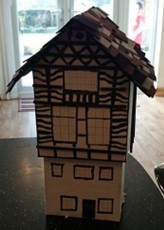
I was reminded of this phenomenon, which I think we probably all can relate to even if we don’t necessarily understand the psychological reasons behind it, when my Facebook account shared with me a memory from ten years ago of a Tudor townhouse that my youngest son (with some help from Dad!) made for a school project. 
As parents and as teachers and leaders in school, we can see this every time we see children produce a cake, a painting, a model or any host of other items, but also in their written work.  I remember as a young teacher, working in a very socially and economically disadvantaged community, being upset upon witnessing a particularly vulnerable child regularly destroy their own work.  It was symptomatic of some very deep-rooted issues the child was experiencing, and was a very clear manifestation of their own lack of self-worth. 

As professionals in schools, we also see value in our own work (the lesson plans and resources, the schemes of work, the assemblies we create etc. etc.) beyond what others may see in it.  We have an emotional connection with it.  It is an expression of our expertise and experience.

As a Trust, we recognise this.  Whilst seeing the inherent efficiencies of collaboration and standardisation, we also understand the necessity for personal contribution.  Our subject leaders, subject experts and secondees are leading colleagues across schools and subjects in genuine processes of co-construction of programmes of study.  We agree the “what”, and the “when”, but only some of the “how”.  This gives scope for teachers to consider their classes, and their communities, and their own teaching skillsets.  Without such considerations, lessons are all, in effect, “cover lessons”.  Likewise, we support our school leaders with a policy suite, robust systems and structures for finance, HR, governance and safeguarding, whilst allowing them the same considerations of context as the teachers they work alongside.  We aim to “support, not stifle”.  That way, all can genuinely feel the IKEA Effect in school.

Finally, in the same way as the child who brings home their cupcakes takes great pleasure in seeing them eaten by others, and the child who painted the picture beams when it is displayed on the fridge door, so we should derive pleasure from sharing our work.  Next month, I’ll be blogging about The Vault, our revamped online space for colleagues across the Trust to share their work with their colleagues.  It relies on the generosity we have in abundance across our schools.

As always, thanks for reading my blog.  This blog is part of my own IKEA Effect!

Mike

CEO’s Blog: January 2023: “Prepare your children for the road.”

I will start this month’s blog by wishing you a Happy New Year, and every best wish for the year ahead. 

At the time of writing, we are preparing for the official opening of Fradley Park Primary and Nursery School, our latest free school to open its doors to children and their families.  The school’s journey, from a vision and an application by John Taylor MAT way back in April 2017 through numerous project meetings and engagement events to the admission of children into nursery and reception classes in September 2022 was a lengthy one.  There were some bumps in the road, certainly – and this is only to be expected with ambitious and complex proposals – but the journey was sustained through great partnership working and a common belief in and understanding of what we sought to achieve: a school in which our ambition for the children as individual learners of limitless potential is only matched by our drive to make their experience as engaging and happy as it possibly can be.

This time last year, we issued the following postcard to the families who had expressed an interest in sending their child to the school:

We felt the image was a fitting one, illustrating a young child (in their new Fradley Park sweatshirt!) stepping out with confidence into the world.  I hope you notice that the way ahead for the child is not necessarily an easy or clear one.  In our own journeys, we will rarely find signposts to our side and rose petals under our feet!  Yet we stride forward anyway – as the alternative is simply to stay put, stand still, and let the seasons change and the world turn around us. Drawing on our own childhood experiences, and those of others around us and known to us, we are all acutely aware of how those accurately-titled “formative years” shape us and influence us.  It is with good reason that this message greets children and adults when they enter the school:

I hope to share with you later this month some of the scenes from the official opening on 13th January.  We are looking forward to recognising the achievements of all those who worked tirelessly to transform the school from a blueprint to a community, and celebrating how much the school and its children have to look forward to.

To conclude, I will refer back to the young child pictured in the postcard and ask that you look at that image whilst considering the words of eminent child psychologist John Scardina: “Prepare the child for the road, not the road for the child.” As educators, as parents, and as a society, this should always be our intention.

As always, thanks for reading.

Mike

PS: If you would like to learn more about Fradley Park Primary and Nursery School, Chrissie Allen (Headteacher) and her team would love you to get in touch!

CEO’s Blog: December 2022: “Availability is the best ability.”

Like many of you, I watched the World Cup Quarter Final football match on Saturday evening, which saw England knocked out of the tournament by current-holders France.  Inevitably with such events, especially in an age of social media, the inquests began even before the referee blew his whistle for full time.  Punditry, both paid and amateur, focussed primarily on the two components of management: squad and team selection and in-game tactics and changes.  In amongst the hyperbole and the vitriol of Twitter, I read the quotation I’ve used as a title for this blog with reference to whether a particularly gifted yet injury-prone player should have been selected for the England squad.

“Availability is the best ability” is a wonderfully profound sentiment, attributed to American Footballer Brian Dawkins – although others are also cited with the phrase’s invention.  An alternative, and perhaps more colloquially charming iteration used by many US sports coaches is that “you can’t make the club in the tub”!

The message is an obvious one:  whatever talents and abilities we have, if we are not present and prepared to deploy them then we are not of any value to the collective endeavour at hand.  It is with good reason that the first imperative in “turn up, work hard and be nice” is “turn up”.

It is at times of reflection, or adversity, that we are most aware of the contributions people around us make – or don’t.  We will all have had times when we felt incredibly grateful to those who “step up” and equally downcast when we witness those who “step back”. 

As this term nears its close, I want to thank all those with whom I work who make themselves available – without seeking praise or favour, but merely through a generosity of spirit and the hope that they can make a positive contribution and a difference.  We see this every day and have started highlighting a few of these instances via a regular tweet each Monday and recognising more publicly such efforts through our staff magazine, “JTMATters”.

I’ll close this blog, and this year’s blogs, with an extract from a poem by Ella Wheeler Wilcox which I have cited before but which resonates always:

There are two kinds of people on earth today,
Two kinds of people no more I say.
Not the good or the bad, for it’s well understood,
The good are half bad, the bad are half good.

Not the happy or sad, for in the swift-flying years,
Bring each man his laughter, each man his tears.
Not the rich or the poor, for to count a man’s wealth,
You must know the state of his conscience and health.

Not the humble and proud, for in life’s busy span,
Who puts on vain airs is not counted a man.
No! the two kinds of people on earth I mean,
Are the people who lift, the people who lean.

As always, thanks for reading – and for lifting!

Mike